The origins of tea in Japan
The sancha theory
There are several theories about the origins of tea in Japan, where the tea plant derived from, when and how tea drinking and cultivation started. It is speculated, that wild tea, called sancha (also called yamacha, 山茶) has been growing in Japanese mountains and tea drinking started from this wild tea. But historical documents prove that the habit of tea drinking was imported from China. Further, sancha was found only close to settlements, but not deep in the mountains and therefore, this theory has never been approved. I am not sure, what to think about this theory, if it was ideologically motivated or not, but I assume that further research on the origins of the sancha theory would make an interesting research paper.
Kentō-shi and tea
Before I talk about tea, I would like to talk about about kentō-shi (遣唐使), but for those who aren’t interested in that topic can skip this part until the next paragraph. During Asuka period (Asuka jidai, 飛鳥時代, 538-710), the following Nara period (Nara jidai, 奈良時代, 710-794), and early Heian period (Heian jidai, 平安時代), Japan had vivid connections to Sui dynasty (Suí-cháo, 隋朝, 581–618) and the succeeding Tang dynasty China (Táng-cháo, 唐朝, 618–907). Chinese culture and lifestyle were imported to Japan, as well as Buddhism. That happened through diplomatic envoys which started under the name kenzui-shi (遣隋使) during the Sui dynasty and later, during the Tang dynasty, they continued under the name kentō-shi (遣唐使) between 607 and 839. Countless aristocrats, Buddhist priests and monks were sent to China for studies in order to return home with new knowledge. Ships with 250 to 500 people were sent via two routes. One was via Kyūshū, along the shores of the Silla kingdom (新羅, 57BCE-935) in Korea, but when the relationships to Silla got worse after the Battle of Baekgang (or in Japanese, Battle of hakusukinoe 白村江), kentō-shi took the sea route in the south, first via Ryūkyū (琉球) and later directly to China, which at that time was still highly dangerous. Because of that, and also because of the political instability in the end of the 9th century China due to a rebellion, Sugawara no Michizane (菅原道眞, 845-903), a political figure of the Heian period, decided to cancel the 20th mission in 894 (寛平6年). This marked the end of kentō-shi and also of a Chinese influenced culture in Japan, leading to the spread of a “local” Japanese culture (kokufū bunka, 國風文化) instead.
Drinking the first tea in Japan
Thanks to the kentō-shi envoys, in the end of Nara period, along with Buddhism, tea as brought to Japan. Famous priests who studied in China and are associated with tea were Saichō (最澄, 767-822) and Kūkai (空海, 774-835) who both joined the 19th (last) envoy in 804. Both are famous as founders of esoteric schools of Buddhism: Saichō for founding the Tendai school of Buddhism with its center on mount Hiei and Kūkai (in honor also called Kōbō-Daishi, 弘法大師) for founding the Shingon school of Buddhism with its center on Mount Kōya.
The first tea brought to Japan was compressed tea or tea cake. The needed amount of tea was cut from the cake and boiled in hot water and then served. It was limited only to monks and aristocrats and used as a medicine. One could say, tea was the first energy-drink.
Shōmu-tennō (聖武天皇, 701-765) was the first who officially enjoyed tea in Japan, at least as far as we know from historic texts. According to a text called Cha-kyō shōsetsu. (“Detailed analysis of cha-kyō“, 『茶経詳説』), in the year 729 (天平元年), Shōmu-tennō invited hundred monks to recite the Prajñāpāramitā sūtra (in Japan, it is called hannya-kyō, 般若経) and after the long night, on the next day, they were drinking tea together.
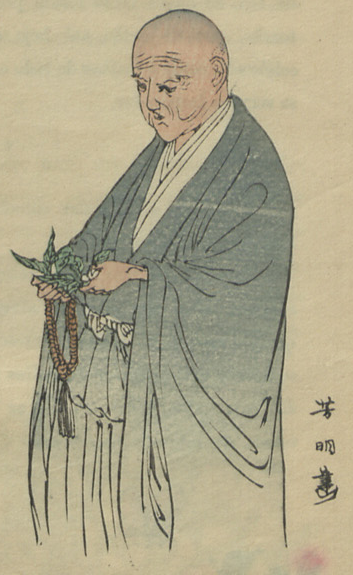

Not only the beverage, but also seeds of the tea plant were brought to Japan. When he returned home in 805 (延暦 24), Saichō planted tea seeds at the foot of mount Hiei, in Sakamoto, Ōmi no kuni (近江国, now Shiga prefecture). The tea garden is called Hiyoshi-chaen (日吉茶園), which is the oldest known tea garden. It still exists and is located near the Sakamoto Hieizan-guchi station of Keihan line. Also Kūkai is said to have brought seeds of the tea plant to Japan.
According to the chronicle Nihon-kōki (『日本後紀』,「大僧都永忠手自煎茶奉御」,792-833), the Buddhist priest Eichū or Yōchū (永忠, the correct reading is unknown, 743-816) served tea to Saga-tennō (嵯峨天皇, 786-842) when he stayed overnight at the temple Bonryaku-ji (梵釈寺) in 815 (弘仁 6)in 815 (弘仁 6). Saga-tennō, who became fond of the refreshing beverage, supported the plantation of tea, and the beverage gained popularity among aristocrats. However, this trend declined, after Sugawara no Michizane broke the ties with China. Tea then wasn’t enjoyed in Japan until the 12th century.
References (*for this article, I used Japanese literature, but I also found some internet links in English, for those who are interested)
小川後楽『煎茶入門』東京、保育社、1976年(¹1962年)。
賣茶翁高遊外著/富岡鉄斎加筆書『梅山種茶譜略』佐賀、特別非営利活動法人 高遊外売茶翁顕彰会、(1748年)。
神津朝夫『茶の湯の歴史』東京、角川書店、2009年。
橋本 実『お茶の謎を探る』東京、悠飛社、2002年。
藤原冬嗣『天理図書館善本叢書和書之部 ― 日本後紀(第28巻)』東京、八木書店、1978年。
Links
Matsushita Satoru. “Is Yamacha considered to be a native plant of Japan?” In: O-cha.net. http://www.o-cha.net/english/teacha/history/yamacha.html (Accessed 2019-02-18).
Osborne, Donald. “Green Tea – History in Japan.” In: Tea time 365. http://tea-time365.blogspot.com/2013/09/green-tea-history-in-japan.html